
The Sun Prairie Business Park is home to a 70-year-old company whose quality product has been used in the Kohl Center, American Family Field, Lambeau Field, Monona Terrace Convention Center, the Epic campus in Verona and Camp Randall Stadium — as well as thousands of Wisconsin homes.
Although celebrating 70 years in business, Hallman Lindsay Paints is also marking 40 years in the Sun Prairie Business Park — a feat that company Marketing Leader Jason Malina attributes to owner Tim Mielcarek’s “love, serve, care” philosophy and Hallman Lindsay’s employees.
Established in 1956 as Hallman Paints on Main Street in Madison, the company’s founders were Bill Hallman, Bob Lindsay and Don Dega.
Sometime shortly after helping to co-found the company, Bob Lindsay left to start Lindsay Finishes.
Separately, both Hallman Paints and Lindsay Finishes enjoyed steady growth. In 1976, Hallman Paints moved to Sun Prairie to increase manufacturing capability and in 1991 Hallman Paints bought Lindsay Finishes to form Hallman Lindsay Paints.
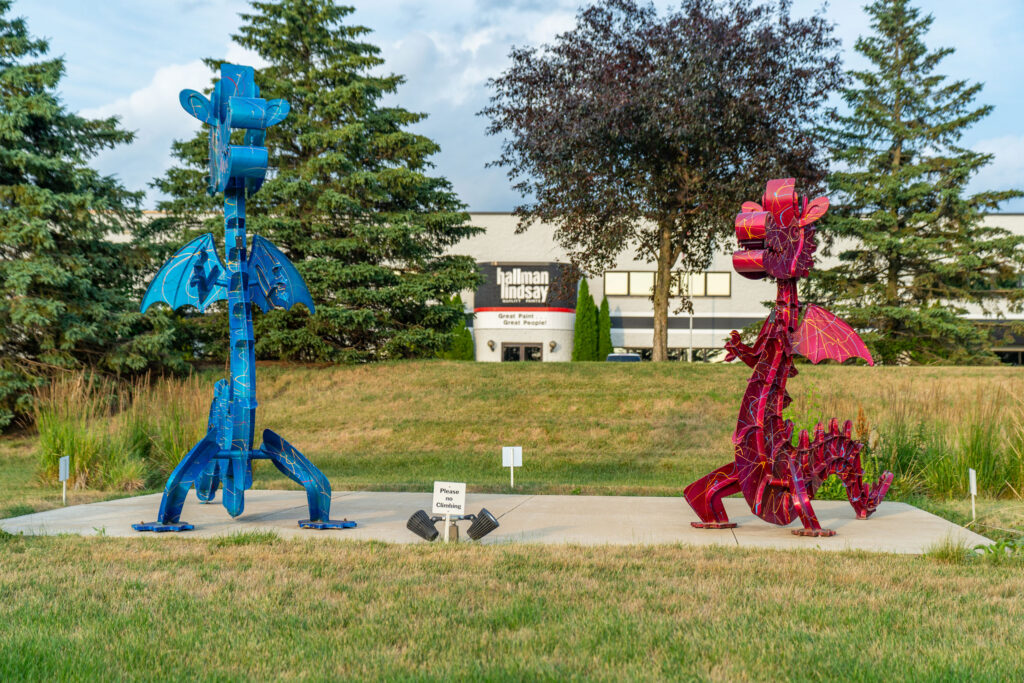
The company moved to the Sun Prairie Business Park in 1998 into a plant that remains one of the most updated in the U.S., totaling 82,000 sq. ft. on 11 acres of land. The plant also features one of 27 Hallman Lindsay Paints stores located throughout Wisconsin. The company remains the only remaining Wisconsin-based paint manufacturer making its own paint sold in its own stores.
Jason used his own career as an example of the “love, serve, care” philosophy practiced by the company.
“This is the first time in my career where I’ve had the opportunity to make decisions because they’re the right decisions, not necessarily because they’re the right decision for the bottom line,” Jason said.
“What’s right for the community may not be the best decision for our numbers, but it’s the right thing to do for the community. I think that mindset carries over to the employees as well. There are certainly — for a small organization with less than 225 employees — a significant amount of very tenured employees here,” Jason said.
Community — and product — pride
Jason also said — in addition to the previously listed famous locations where Hallman Lindsay Paints have been used — there is another location that he said gives him a sense of pride.
“We don’t necessarily publicize where all of our paint gets used. It is certainly prominent in some very high visibility locations throughout the state. Recently, the Welcome to Wisconsin signs got refinished, got some new stain on them, just a fresh new look, and that was our product,” Jason said. “It’s super exciting to see those kinds of projects, where you know it’s local paint being used by local painters to work on local projects. It’s so cool to see.”
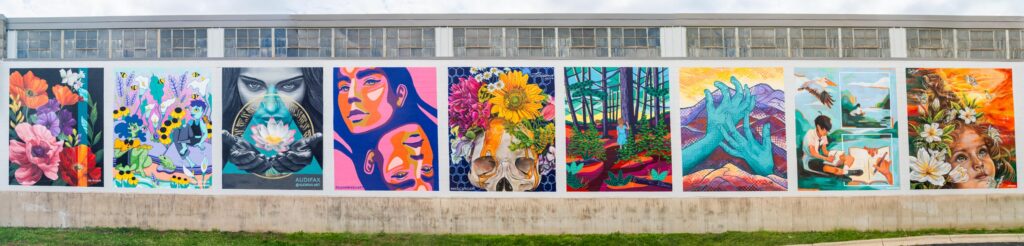
Another area not widely publicized by Hallman Lindsay is the company’s community involvement — particularly with Mural Fest, which celebrated its second installation of artwork in Downtown Sun Prairie in 2026.
Lena Ugren, who is the organizer of Mural Fest, approached the company in early 2025 with a sponsorship opportunity.
“From the get-go, it absolutely made sense. I mean, it is a festival showcasing the ability of the artists and the murals they’re putting up on the walls, so it’s absolutely the right product for us as a paint company,” Jason said. “But, going back to our commitment to the community for a Sun Prairie-based business, this is Sun Prairie Mural Fest. It just made sense.”
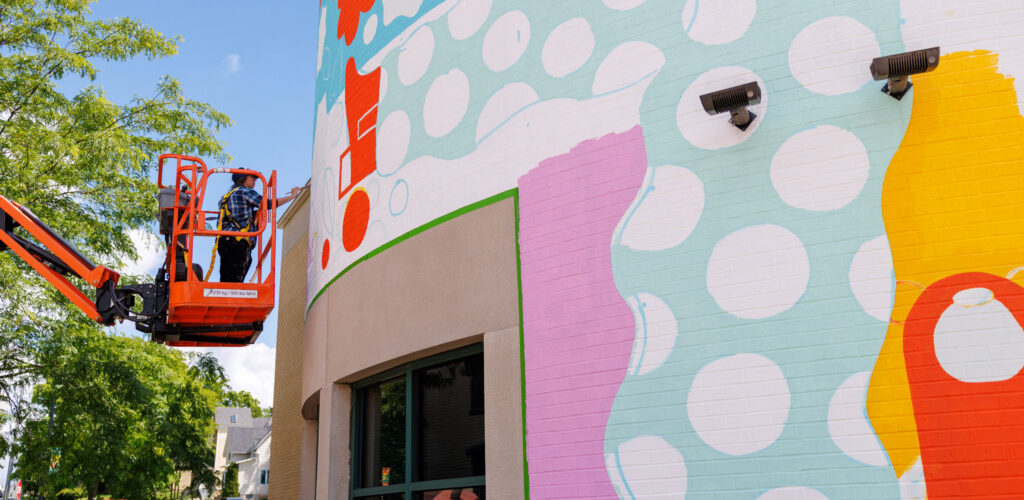
“I was able to work with the Mural Fest team and kind of say, ‘Hey, in lieu of a monetary donation, does it make more sense for us to actually just donate the paint and supplies that you need for all of the artists?’ At the end of the day, they walk away with probably more value than the monetary donation would have given them, and in turn we’ve developed a great relationship with them,” Jason said, adding that the company donates the paint and all the items needed to do the painting for Mural Fest.
Another area where community is involved is food pantry donations.
“One of the things that we do, and this is not necessarily local to Sun Prairie, but we’ve got 33 stores across now three states, and every year we do an annual food pantry donation,” Jason said “We’re very much proponents of supporting the local markets and giving our local stores kind of the empowering them to kind of make that happen. We rely on each of our stores annually to identify a food bank or a food pantry partner, and we donate $1,000 to each of those food banks every year.”
The company also has other charitable involvements. “We just met with the Girl Scouts last week about some things to help them with one of the opportunities they’re working on pursuing. We don’t necessarily advertise a lot of what we do on the charitable side, but there are things happening pretty much on a weekly basis. In addition to the donations that that we give, our owner, Tim, also maintains his own charitable fund, and that nonprofit additionally donates quite a bit to the community.”
Quality you can see
Without a quality product, none of the company’s charitable involvement would be possible. Jason describes the paints and stains as second to none in the market.
“There’s really three pillars that I talk about when I talk about our products — the first is the quality of the products — we’re absolutely spot on talking about that,” Jason said. “Once people try our products, they love our products because we put a lot of emphasis on the engineering piece of it. We put a lot of emphasis on quality raw materials.”
The second aspect of the company is its people, with three chemists helping to formulate its products. “We talked about the longevity of our people, but what comes along with that is the product knowledge that you can’t match,” Jason said, adding that Hallman Lindsay has been working with some of Wisconsin’s top interior designers for years.
The third pillar is Made in Wisconsin. The first floor Hallman Lindsay conference room could actually be renamed Bucky’s Second Home because of the amount of Badgers memorabilia within — ranging from photos and souvenir items to autographs from a Who’s Who of Badger Greats like Barry Alvarez and Dick Bennett. That Made in Wisconsin quality is something that makes Hallman Lindsay unique — from the first floor conference room to its line of products, according to Jason.
“When we talk about some of the projects in Wisconsin,” Jason added, “it is so cool to see Wisconsin-made paint being applied by Wisconsin painters on Wisconsin properties and landmarks.”
O’Leary and the future
Slightly more than two years ago, the company acquired another established Michigan company, O’Leary Paints.
The acquisition allows Hallman Lindsay to build on its foundation and deliver more value to the customers without changing the people or service they trust, but with the goal being to ultimately rebrand those locations as Hallman Lindsay.
The acquisition made sense because Hallman Lindsay has manufactured paints for the Midwest’s bitterly cold climates and, combined with O’Leary, will be a larger Midwest company.
The company website notes the acquisition strengthens Hallman/Lindsay’s position as a leading independent paint manufacturer in the Midwest with an expanded retail footprint and enhanced capabilities to support professional contractors, property managers and homeowners.
Looking further into the future, Jason said he believes Hallman Lindsay is fully capable of handling the projected growth Dane County is expecting.
Local planning and demography specialists project growth of 16.5% per decade, estimating 887,000 people in Dane County by 2050, according to the Capital Area Regional Planning Commission. The Wisconsin Department of Administration (DOA) projects a population of 778,000 by 2050, assuming an overall population decline but still a substantial increase from the population of 561,504 recorded in 2020.
“I think we’re extremely well positioned to continue to handle growth. I think we’re on track for about 1.8 million gallons of production in 2026 out of this facility, and there is absolutely room to grow that production,” Jason said. “On top of that, the plant here was built in a way with expansion in mind, so the plant was built 30 years ago, but there is the opportunity to expand it and make it a larger footprint should that need arise.”